by Wendell Cox
Principal, Wendell Cox Consultancy
Policy Report #21
James Madison Institute
April 1997
About the Author
Mr. Cox previously served as Director of Policy for the American Legislative Exchange
Council (ALEC) and is the co-author of a Cato Institute policy study entitled Amtrak at
25: The End of Taxpayer Subsidies?
Table of Contents
II. HIGH SPEED RAIL: INTERNATIONAL EXPERIENCE
| Tables | ||
| No. | Title | |
| 1 | Proposed Public Purposes of High-Speed Rail (Benefit to Florida) | |
| 2 | Passenger Transport Market Share: 1994 (Person Miles) | |
| 3 | Change in Passenger Transport Market Share: 1980-1994 | |
| 4 | High-Speed Rail Corridors, FRA Feasibility Study: 2020 | |
| 5 | High-Speed Rail Corridors, Demographic Factors | |
| 6 | Comparison of FOX 1995 Air Fares and 1996 Air Fares | |
| 7 | Estimated Travel Time | |
| 8 | Estimated Travel Costs | |
| 9 | Evaluation Assumptions: Summary | |
| 10 | Evaluation Results: Summary With On-Time Opening | |
| 11 | Evaluation Results: Summary With 18-Month Delay in Opening | |
| 12 | Daily High-Speed Rail Diversion from Automobiles and Highway Travel Demand: 2010 | |
| 13 | Evaluation: Public Purposes of High-Speed Rail (Benefits to Florida) | |
| Charts | |
| No. | Title |
| 1 | Comparison of Florida and Japan Rail Corridor Urban Population | |
| 2 | Projected Market Share: 2010 | |
| 3 | Airline Market Share: Orlando to South Florida, 1996: First Nine Months and Last Three Months | |
| 4 | Miami-Orlando Business Trip: Costs | |
| 5 | Personal Trip Costs/Fares | |
| 6 | Average Hourly High-Speed Rail Diversion from Autos Compared to Single Highway Lane Capacity | |
| 7 | Hourly One-Way Capacity: Highway Lane Compared to FOX Theoretical and Actual | |
| 8 | High-Speed Rail: Assumption-Based Planning | |
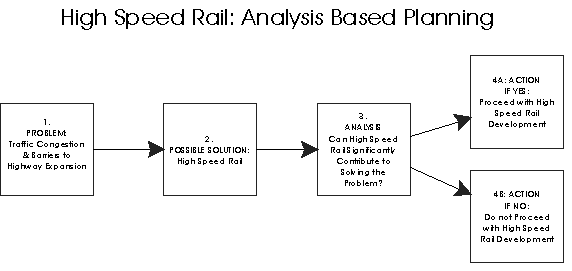
| 9 | High-Speed Rail: Analysis-Based Planning | |
EXECUTIVE SUMMARY
A high-speed rail line has been proposed for the 322-mile corridor from Miami through Orlando to Tampa with trains operating up to 200 miles per hour. The Florida Department of Transportation (FDOT) and the developer, Florida Overland Express (FOX), believe that the line would attract significant numbers of travelers from automobiles and airplanes. As a result, FDOT and FOX forecast that highway traffic congestion (gridlock) and air traffic congestion (winglock) would be alleviated, reducing requirements for highway and airport expansion. They also predict that various other environmental, traffic safety, and economic benefits would ultimately be enjoyed by the state because of this project.
The FOX line would require nearly $3.5 billion in subsidies. The state of Florida would provide $3 billion in subsidies, the federal government $300 million, Orlando International Airport $100, million and Miami International Airport $50 million. FOX would provide $350 million in equity, construct the line, build the trains, and operate the system for 40 years. Infrastructure debt of $6.5 billion would be incurred.
The proposed high-speed rail system is likely to be a financial disaster for Florida. This analysis, based upon FDOT, FOX, and generally available planning and market data, finds that high-speed rail is exceedingly unlikely to live up to the claims of its promoters. High-speed rail is likely to cost much more, carry fewer passengers, and expose the state to greater financial risk than is presently anticipated.
High-speed rail operates in Japan and Europe along highly populated corridors where the lines are fed by well used city transit systems. Those lines are an integral part of comprehensive intercity rail systems that provide frequent service in both Japan and Europe. High-speed rail fares are competitive with or below the cost of competing modes of transport (autos and airlines). Nonetheless, rail market shares are declining and impending airline deregulation is likely to significantly challenge high-speed rail in both Japan and Europe.
The market for high-speed rail is more challenging in the United States. Lower population densities, less used transit systems, and the absence of frequent connecting intercity rail service are significant disadvantages for high-speed rail in this country. Near high-speed rail service (125 miles per hour) operates in the New York-to-Washington corridor, but no genuinely high-speed rail systems operate. Two recent national studies--one by the United States Department of Transportation Federal Railway Administration and another by the National Research Council--have concluded that high-speed rail is not commercially viable in the United States.
The forecasts of officials planning large infrastructure projects have tended to underestimate costs and overestimate usage: Denver's International Airport experienced cost escalation of 300 percent, and the English Channel Tunnel cost 140 percent more than expected. Boston's Central Artery/Tunnel has doubled in cost. All three projects experienced opening delays of at least one year. Usage forecasts have also been inaccurate. Florida project forecasts have also been inaccurate both in costs and usage. Examples include Miami's Metrorail and Metromover, Tri-Rail, and Jacksonville's Sky Express people mover line. Even Florida's Turnpike authorities significantly overprojected demand for its newest roads, despite decades of experience.
The Florida market is comparatively unfavorable to high-speed rail. The Miami-Orlando-Tampa corridor has much less population and lower population densities than high-speed rail corridors in Japan, Europe and New York-Washington. There is no frequent connecting intercity rail service and transit services are poorly patronized.
The FOX high-speed rail line would have no advantage over airlines. FOX fares are projected at 30 percent or more below air fares. However, in recent months the South Florida-Tampa and South Florida-Orlando air markets have been entered by discount air carriers, and average air fares have dropped significantly--the average airfare is now 15 percent below FOX's anticipated average rail fare. In the Miami-to-Orlando market, rail travel times will be similar to that of the airlines, while rail will face a one hour disadvantage in the Miami-to-Tampa market. Further, the airlines are likely to become more competitive in future years.
The FOX high-speed rail line would be far more costly than autos. FOX fares are projected at 33 to 250 percent above the full cost of business automobile travel. FOX fares would be from two to 20 times the cost of a personal auto trip.
The FOX high-speed rail line would be slower than autos for some trips and faster for others. FOX travel times would be one hour and 30 minutes faster than autos, door to door between South Florida and Tampa or Orlando. However, high-speed rail would be slower than autos between Orlando and Tampa. This represents a major problem because FOX projects one-third of its ridership would be attracted from autos in the Orlando-to-Tampa corridor--a distance far too short to provide a competitive advantage to high-speed rail.
This study projects that ridership under favorable circumstances would be 55 percent below FOX estimates, as the ridership projections are extremely optimistic. Both FDOT and FOX state that high-speed rail will capture more than 65 percent of the airline market. This would be a formidable task even if rail fares were well below air fares, but air fares are already lower than projected high-speed rail fares. The predicted diversion from autos is very high in light of the auto's travel time advantages in short markets and its overall cost advantages. The lower population densities, lack of connecting rail service, and low levels of transit usage would also impair high-speed rail patronage.
The FDOT and FOX high-speed rail cost projections are highly optimistic. The projected operating and capital costs are lower than industry estimates, and the forecasts do not include a contingency fund to accommodate the significant cost escalation characteristic of projects of this size.
High-speed rail is likely to cost Florida much more than projected. In the best case, this report estimates that the state of Florida would be required to increase its subsidy from $3 billion to $14 billion, and in the worst case to nearly $39 billion. It is unlikely that commercial revenues will be sufficient to pay debt service by the fourth year (out of 40 years). The financial projections are so fragile that small operating and capital cost overruns could force a default on debt in less than 10 years even if FOX generated its projected fares and commercial revenues (which this report considers well beyond realistic).
The state of Florida would assume virtually all of the risk. Because the state would be required to guarantee project completion and operation, its obligation would be open-ended (up to $39 billion). FOX's risk would be limited to $350 million.
High-speed rail would not materially improve the environment, air traffic congestion,
or highway traffic congestion despite the claims of promoters.
The impact upon the environment would be negligible or even negative.
Because high-speed rail would reduce automobile traffic by a negligible
amount, increased highway investment would produce greater improvements
in traffic safety.
The problem of air traffic congestion--winglock--has been exaggerated. All
airports in the Miami-Orlando-Tampa corridor are expanding or intend to
expand to accommodate rising demand. Even if the unrealistic FOX
projected diversion from the airline market share were to occur, it would still
only reduce airline operations by 2 percent. FOX would not reduce the
demand for airport expansion, which is more cost effective than building
high-speed rail.
The problem of highway traffic congestion--gridlock--is more difficult. But
FOX would remove so few automobiles from highways that traffic
congestion would essentially remain unchanged. Diversion from automobiles
would average 1/30th of the traffic in a single traffic lane. Thus, FOX would
not reduce the demand for highway expansion, which is more cost effective
than building high-speed rail.
FDOT has adopted a policy of preference toward high-speed rail which could actually injure Florida's economy. The state bias would result in greater highway congestion and impede Florida products in reaching their markets. Also, the likely high-speed rail cost escalation would require funding sacrifices in other public services, or tax increases, which reduce economic growth and job creation.
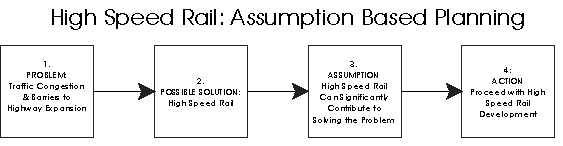
High-speed rail planning is based upon assumptions, not analysis. FDOT and FOX claim that high-speed rail would produce transportation, environmental, and economic benefits for Florida. They are proceeding with high-speed rail on the assumption that high-speed rail's theoretical benefits would be achieved, without a critical examination of the likely actual benefits.
This analysis concludes that even if FDOT-FOX ridership projections were achieved, high-speed rail would have at best negligible impact on either transportation or the environment, because so few people would be diverted from autos or airlines. More importantly the FDOT and FOX projections are extremely optimistic--thus not even the negligible results are probable. Consistent with existing large infrastructure projects:
In sum, the proposed Florida Overland Express high-speed rail system would provide only
negligible benefits, but its cost to Florida would be enormous.
I. INTRODUCTION
The Emergence of High-Speed Rail
High-speed rail systems have been operating in Japan since 1964 and in France since 1981.
High-speed rail has generated interest in the United States as well. High-speed rail has been
proposed as a strategy to relieve highway congestion (gridlock) and air traffic congestion
(winglock) in markets of under 500 miles. This, proponents claim would reduce the
necessity for highway expansion and air system expansion (which, it is claimed, is limited
by the inability to "build new airspace").(1)
Proponents also claim that a significant air
pollution improvement would result as high-speed rail captures a large portion of the
intercity travel market from automobiles and airlines.
A high-speed rail line has been proposed for a 322 mile corridor from Miami through
Orlando to Tampa. Top operating speeds would be 200 miles per hour. The line would be
in operation by 2004, and would be financed by private developer capital of $350 million,
local state and federal funding of nearly $3.5 billion, and commercial revenues, primarily
passenger fares (all financial data is in constant 1995 dollars unless otherwise noted). The
cost of this construction project will be approximately $6.5 billion, most of which would
be raised through the sale of bonds.
Purpose of this Report
Most previous planning documents on the proposed Florida project evaluated high-speed
rail on its theoretical capabilities. This study evaluates high-speed rail's potential to reduce
highway and air traffic congestion. It
Most of the financial and ridership data is for the year 2010, the planning horizon used by
FDOT and FOX.
Based upon an analysis of available planning and market data, this report finds the Florida
high-speed rail proposal to be extremely optimistic. High-speed rail is likely to cost much
more, carry many fewer passengers, and require considerably higher state subsidies than
planned. Moreover, high-speed rail's impact on transportation, the environment, and the
economy would be generally negligible or even negative.
The Public Purposes of High-Speed Rail
The state of Florida Department of Transportation (FDOT) has awarded a franchise to
Florida Overland Express (FOX), a limited partnership between Fluor Daniel, Odebrecht
Contractors of Florida, Bombardier, and GEC Alsthom. FOX was selected through a
competitive process that attracted five proposers.
The state legislature, in enacting legislation to authorize high-speed rail development,
stated that high-speed rail was to "solve transportation problems and eliminate their
negative effect on the citizens of this state." State legislation expresses the expectation that
high-speed rail would "eliminate unduly long and traffic-congested commutes for day to
day commuters," create employment, encourage development, generate economic growth,
reduce traffic fatalities, reduce the cost of automobile accidents, and generate
environmental benefits.(2)
The legislature expects high-speed rail to provide much needed
transportation capacity in Florida:
Beyond the benefits anticipated by the legislature, FOX indicates that high-speed rail would
provide a substantial boost in transportation capacity at considerable savings to Florida.
FOX estimates that construction of a new four-lane expressway from Tampa to Orlando to
Miami would cost $8.9 billion, at least $3 billion more than the proposed high-speed rail
line. Further, FOX indicates that the high-speed rail line would be "capable of transporting
the equivalent of approximately 10 lanes of traffic when operating at maximum capacity,"
and that the high-speed rail system "will yield a far greater traffic mitigation return to the
State than expansion of the Florida highway network."(4)
FDOT policy limits the number of lanes on state highways. The policy restricts Florida's
Turnpike to four lanes (two in each direction) between Kissimmee and the northern Palm
Beach County boundary. This segment of roadway serves virtually all of the South Florida
to Orlando automobile traffic, and is the only segment along the high-speed rail corridor
that is not urban. The policy states that additional capacity will be provided by "other
alternatives and strategies," and indicates that:
Moreover, FDOT expects the project to remove 21,000 annual airline flights in the Miami-Orlando-Tampa corridor.(6)
According to FOX, the service would offer "nearly the speed of
air travel but at a cost that compares favorably to auto travel." With 24 trains daily in
2010, FOX claims that it would "offer more departures than is possible by air."
The proposed high-speed rail benefits to Florida (public purposes) are listed in Table 1.
II. HIGH-SPEED RAIL: INTERNATIONAL EXPERIENCE
Japan
The world's first high-speed rail line--Japan's "bullet train"--began operation in 1964. The
first trains traveled at top speeds of 130 miles per hour, while more recent trains have
operated at up to 186 miles (300 kilometers) per hour.
When service was initiated, Japan was a much poorer country than it is today. Automobile
ownership was very low; there was one automobile for each 46 persons in 1965.
Commercial air service was limited, and railroads accounted for 67 percent of passenger
travel, while automobiles carried only 11 percent.
Japan's original line, from Tokyo to Osaka through Nagoya, is 320 miles long. It travels
through some of the largest urban areas(7)
in the world: Tokyo-Yokohama (Tokyo), with
more than 30 million people, is the world's largest urban area; Osaka-Kobe-Kyoto
(Osaka), with more than 15 million, is the world's sixth largest urban area; and Nagoya
ranks among the top 40 urban areas, with more than five million. Other factors favor high-speed rail.
High urban population densities: The (central) city of Tokyo has 41,000 people
per square mile. The urban (developed) area densities in Nagoya, Osaka, and Tokyo
range from 15,000 to nearly 30,000 per square mile. The three metropolitan areas
along the original high-speed rail route have a population of 52 million with more
than 160,000 people per route mile.
Extensive transit networks feed the high-speed rail system. Tokyo-Yokohama
ridership alone is approximately three times that of the entire United States
population. Unlike the rest of the developed world, most urban transit service in
Tokyo, Nagoya, and Osaka is profitable, with buses, interurban rail lines, and even
subways privately owned.
Extensive rail network: Japan has an extensive intercity rail network focused on
city center stations where there is convenient access to high-speed rail services.
Further, Japan's geography is particularly favorable to high-speed rail. The main
island of Honshu is from 50 to 200 miles wide. The 1,000 mile main high-speed
rail line is within reach of more than 100 million people either directly or by
frequent connecting rail service. Almost all of Japan can be reached within a day by
rail.
High-speed rail is priced competitively compared to other modes of transport. For
example, the $123 one-way fare from Tokyo to Nagoya (200 miles) makes high-speed rail
very attractive.
High driving costs: The cost of gasoline and tolls alone is nearly $110. Gasoline is
expensive--nearly $3.40 per gallon as a result of domestic refiner protection and
120 percent taxation. The highway tolls between Tokyo and Nagoya are
approximately $75.00.(8)
Parking is much more restricted and more expensive than in
the United States, which raises the cost of driving even more. The full price of
driving, including auto purchase, taxes, insurance and maintenance, is well above
high-speed rail fares.
Restricted air market: The airline market has been strictly regulated, both in fares
and service frequencies. Airline deregulation is beginning, as the nation's first new
airline in more than 40 years has recently been authorized. The economy airline fare
has dropped to $116. However this advantage can be more than eliminated by high
parking charges, airport access tolls, or taxi fares.
In the intervening years, Japan has emerged as one of the world's most affluent countries.
And, despite the advantages of high-speed rail, automobile use has increased exponentially.
Automobiles now account for 52 percent of travel in Japan, while the rail market share has
been nearly cut in half, to 35 percent.(9)
Nonetheless, high-speed rail carries volumes of up
to 23,000 passengers per hour in one direction in the Tokyo area.(10)
But new high-speed rail construction has become politicized. In the past, high-speed rail
lines have been built to accommodate rising rail demand on crowded rail corridors.
Commercial passenger railroad companies have expressed(11)
concern about the commercial
viability of the new routes, which have been called "hopelessly uneconomic."(12)
Future
routes would be built with government capital subsidies of at least 50 percent.(13)
Japan has exceedingly dense rail corridors that connect some of the most crowed urban
areas in the developed world. Japan is a uniquely favorable environment for operation of
high-speed rail. Nonetheless, as airline deregulation proceeds, high-speed rail could be hard
pressed to maintain its market share.
France
Like Japan, France built high-speed rail to accommodate growing demand on its rail
system. Operations on the first route, Paris to Lyon, began in 1981. Three routes now
radiate from Paris. One of the lines reaches the English Channel tunnel (Eurotunnel),
through which the Eurostar service operates to London.
Population densities are lower in France than in Japan. However, the hub of the French
system, Paris, is continental Europe's largest metropolitan area, with more than 10 million
people. Paris is very densely populated. The central city has 53,000 people per square mile,
while the metropolitan area has nearly 20,000 per square mile. Other large French
metropolitan areas are also densely populated and have extensive and well-used transit
systems that feed central city rail stations. The population per route mile along the Paris to
Lyon corridor is more than 45,000.
Further, France's high-speed rail services are an integral part of a much larger passenger rail
network throughout Europe. Even before service began to England through the
Eurotunnel, more than 200 million people were connected by this system with frequent
daily departures.
High-speed rail fares compare favorably to other modes. For example, the present coach
class (second class) fare from Paris to Lyon (264 rail miles) is $74. In contrast:
Highway tolls and gasoline for the same trip by auto total $91--more than 20
percent higher than the rail fare. Gasoline is taxed at approximately 400 percent and
costs more than $4.50 per gallon, while highway tolls in this corridor are
approximately $30. Full automobile costs, including purchase, insurance, and
maintenance are higher. A further disadvantage to travel by auto in the Paris to
Lyon corridor is that it is 21 miles longer than the rail journey.
The one-way coach airline fare for the same trip is $192, more than two and one-half times the rail fare. High air fares in high-speed rail corridors have been a staple
of French regulatory policy, which requires an "appropriate" spread over rail fares to
encourage rail usage.(14)
France also banned competing bus service on this route to boost high-speed rail
ridership.(15)
Ridership along the already heavily traveled rail corridor from Paris to Lyon has increased
by nearly 70 percent, from 12 million to 20 million.(16)
However, reflecting the importance
of the extensive rail network (of which high-speed rail is a part), only 25 percent of the
riders in the corridor begin and end their travel in Paris, Lyon or in between.(17)
Approximately 35 percent of the new high-speed rail ridership has been attracted from
airlines and 20 percent from automobiles, while 45 percent is "induced" trips -- new
trips.(18)
Despite its considerable speed and price advantages, high-speed rail has attracted
only 10 percent of the Paris to Lyon automobile travel.(19)
Like the United States, France is an automobile dependent nation. Automobile travel
volume is 11 times that of rail, and rail is losing market share.(20)
The nation is now building
1,500 miles of new expressways, while some new high-speed rail construction has been
delayed or even halted.(21)
Since 1980, bus ridership has increased by a larger number of
riders than rail ridership.
The artificially constrained domestic airline market was deregulated April 1, 1997. The
previous deregulation of European air services between countries has already produced
drastically lower fares in some markets. It seems likely that high-speed rail's fare advantage
is likely to be eroded, if not eliminated entirely. In the longer term, airlines are likely to win
market share from high-speed rail. French high-speed rail services will face more
competitive challenges in the future.
Europe in General
While France has been the European leader in high-speed rail, lines have been or will be
built in other European nations. Besides France, high-speed rail is operating or is planned
in countries such as the United Kingdom, the Netherlands, Belgium, Spain, Germany,
Switzerland, and Italy. When complete, the European high-speed rail system is expected to
attract 3 percent of highway traffic, equal to one-year's growth in European highway
demand. When Sweden implemented high-speed rail service, 62 percent of the new
ridership came from airlines and only 8 percent from automobiles.(22)
Replicating what
would be expected in a competitive market, English Channel ferry companies responded to
Eurotunnel train services by reducing their fares and expanding services.
Europe is far more automobile dependent than Japan. Nearly 80 percent of European
travel is by automobile and 6.2 percent is by rail. Since 1980, the rail market share has
dropped by more than 25 percent while airlines have expanded their market share by 80
percent to nearly equal that of rail.(23)
At the same time, the European Union is undertaking
steps to make its passenger rail services commercial, including high-speed rail services.(24)
Maintaining market share is likely to be difficult as the deregulated market increasingly
provides higher levels of service at lower fares.
III. HIGH-SPEED RAIL IN THE UNITED STATES
The Market
The United States is a far more challenging environment for high-speed rail because it
differs from Japan and France in urban development and population density. Urban areas
in the U.S. tend to have 2,000 to 5,800 people per square mile, which is very low
compared to the 15,000 and more that is typical of Japanese and European urban areas.
Transit systems in America are incapable of providing frequent, convenient service to cover
these spread-out areas. The United States covers 25 times the area of Japan, yet has only
two times as many people. Compared to the European Union, the U.S. covers more than
three times as much area and has almost 90 percent as many people. The longer intercity
travel distances rendered America's once extensive national passenger rail system obsolete.
It has been replaced by an airline system that makes it possible to travel from any point to
any other in just a few hours. Deregulation of the airline industry increased service and
lowered fares, bringing airline travel within the financial reach of most income groups.
Amtrak, the remnant of the national rail system, provides infrequent service except along
the Washington-New York-Boston corridor,(25)
but other large metropolitan areas have no
rail service.
Gasoline is priced closer to market rates in the United States, with taxation (mainly
highway user fees) at 40 percent above the market price. Highway tolls are far lower than
in France and Japan, and most intercity expressways have no tolls.
Nonetheless, the United States is not significantly different from Europe with respect to
travel. Automobiles account for 87 percent of travel, compared to Europe's 79 percent.
The largest difference is in rail travel--Americans average 50 mile annually, Europeans 500
and Japanese nearly 2,000 (see Table 2).
Travel trends are similar in Japan, Europe, and the United States (see Table 3). Railway
market share is declining rapidly in all three and airline market share is increasing
substantially. In the United States, airline market share has expanded by more than 25
percent since deregulation, generating a small reduction in auto market share. In both
Japan and Europe, airline market share is rising more rapidly, with a modest increase in
automobile market share in Europe and a substantial increase in Japan. Both Europe and
Japan are in the first phases of airline deregulation, which suggests further escalation of
airline market shares that would steepen the rail market share decline and moderate future
increases in auto market shares.
Near High-Speed Rail: New York to Washington
Amtrak currently provides Metroliner service from Washington, D.C. to New York City,
operating up to 125 miles per hour. The four large urban areas along this 225-mile
corridor (New York, Philadelphia, Baltimore, and Washington) have a population of more
than 25 million, approximately 113,000 people per line mile. However, these urban areas
cover substantially more land area than Japanese or European urban areas.
While its top operating speeds are well below that proposed by FOX, Metroliners operate
fast enough to provide service equal to airline service between origins and destinations in
central Washington and Manhattan. Thus, from a consumer perspective, the barely
perceivable time differences between rail and air service in the Washington-New York
corridor replicate the anticipated air-rail travel time performance that is typical of high-speed rail markets.
Further, Amtrak's Metroliner service has a substantial fare advantage over air fares--Amtrak
first-class fares are 45 percent lower than airline coach fares. Amtrak's express trains are far
more spacious than airline shuttle services, which do not offer first class service. While
suburbanization has made downtown rail station locations less advantageous in most U.S.
travel markets, the New York-to-Washington market retains a strong downtown focus.
New York has by far the most vibrant downtown in the nation, and Washington's federal
offices and downtown are one of the nation's busiest employment centers.
Transit systems in this corridor are the strongest in the nation, but are less comprehensive
and less used than in Europe and Japan. The network of frequent connecting intercity rail
service is meager, and is limited to trains from Boston and Albany to New York.
Amtrak carries approximately 40 percent of the point-to-point Washington-to-New York
combined air and rail market share.(26)
Even so, Amtrak estimates that its services in this
corridor (including passengers using intermediate stations) removes fewer than 500
automobiles per hour from highways along the corridor--approximately 10 percent of
two-way lane capacity. Moreover, as has occurred when airlines have ceased operations, air
carriers in the New York-to-Washington market could accommodate Amtrak passengers
with only temporary inconveniences.(27)
Proposed Projects
During the last two decades, high-speed rail lines have been proposed for commercial
operation in a number of corridors. Detailed planning has occurred for some routes such as
Los Angeles-San Diego, Los Angeles-Las Vegas, Houston-Dallas-San Antonio, and
Miami-Orlando-Tampa. All of these projects have been canceled, in large measure for
failure to attract commercial investment.(28)
Two recent national reports have concluded that high-speed rail is not commercially viable
in the United States. A 1991 National Research Council report(29)
reviewed 33 potential
high-speed rail markets and found:
A study by the Federal Railroad Administration (FRA) similarly found that commercial
revenues would fall far short of costs in all studied corridors over the period from 2020 to
2040 (see Table 4).(31)
The most favorable performance was projected in the Washington-New York-Boston corridor at 55.3 percent, which would require a public subsidy of 44.7
percent. FRA projected that commercial revenues in the Miami-Orlando-Tampa corridor
would cover 37.7 percent of costs, requiring a public subsidy of 62.3 percent.(32)
FRA found ridership would be even lower where discount airlines operated, noting that an
air fare reduction of 30 percent would reduce high-speed rail ridership by 30 percent.(33)
In contrast to this report, neither the National Research Council nor FRA evaluated the
capability of high-speed rail to reduce air or highway traffic congestion or investment
requirements.
IV. FORECASTING INFRASTRUCTURE COSTS AND USAGE
International Experience
Forecasting the costs and performance of major infrastructure projects with a reasonable
degree of approximation is very difficult. Despite relying upon the finest technology, the
most adept computer models, and the sharpest minds, projections for many major
infrastructure projects have been exceedingly inaccurate.
The New Denver International Airport was estimated to cost $1.7 billion when it
was approved for construction. Eight months into construction, costs had increased
60 percent. After opening 16 months late, the cost had escalated to $4.8 billion
(each month of delay cost nearly $20 million), a construction related cost overrun of
$3.1 billion. The higher levels of bonded debt would require approximately $2
billion in additional interest payments, raising the cost overrun alone to $5.1
billion--a more than 300 percent increase over the cost estimate on which the
decision to proceed was made (all figures in 1996$).(34)
The Channel Tunnel between England and France was to have been built for $7.8
billion. Costs escalated to $18.6 billion--an increase of nearly 140 percent, which
does not include the higher cost of interest due to larger borrowing requirements
than projected.(35)
After opening a year late, its first year of operation produced a loss
of $1.5 billion. The competitive response of cross-channel ferry operators reduced
tunnel traffic to below expectations. After failing to pay interest on its debt for
more than a year, a financial bailout was negotiated with creditors converting half of
their loans to equity. This project was privately financed as both the British and
French government were unwilling to provide either public subsidies or debt
guarantees.
The cost of Boston's Central Artery/Tunnel expressway project has nearly doubled
from a projected $5.5 billion to $10.4 billion (1996$). The project is scheduled to
open six years late in 2004.(36)
Amtrak, which was created to salvage the national passenger rail system, was
intended to achieve profitability shortly after its establishment in 1971. Yet Amtrak
continues to post significant losses and taxpayers subsidies have exceeded $15
billion. Amtrak claims that fares and other commercial revenues will eventually
exceed its operating, but not capital costs. The United States Government
Accounting Office has found that Amtrak's financial condition is deteriorating and
that it is unlikely to earn commercial revenues that exceed its operating costs, much
less its capital costs.(37)
Amtrak is now seeking a new federal tax.
Large urban rail projects have consistently cost more to build and operate, attracted
fewer passengers, and generated less passenger revenue than projected. During the
1980s, federally financed urban rail projects cost 46 percent more to build, and 78
percent more to operate than projected. Ridership averaged 59 percent below
projections. So few new passengers were attracted that the annual cost per new
passenger exceeded the cost of leasing a car in virtually all new systems.(38)
In
response to ridership shortfalls, transit agencies have begun to issue radically
reduced ridership estimates shortly before system openings.
The more recently completed Los Angeles-Long Beach light rail project was
estimated to cost $210 million when the Los Angeles County Transportation
Commission(39)
decided to proceed with the project (1981). Costs rose to $500
million by the time final plans had been formalized and nearly $900 million when
completed, a cost escalation of more than 300 percent. Annual operating costs were
150 percent above projection.(40)
Florida Experience
Florida infrastructure projections have also been inaccurate:
Miami's Metrorail cost 33 percent more to build and 42 percent more to operate
than projected. Daily ridership was to have been 239,900 by 1988 but by 1995 was
only 47,800, 80 percent below projection.(41)
As a result, the cost per rail passenger
was nearly nine times the projection.(42)
Miami's Metro mover (people mover) cost 106 percent more to build and 84
percent more to operate than projected. Daily ridership was to have been 41,800 by
1988, but was under 13,300 in 1995, 68 percent below projection despite a more
than doubling of the route's length.(43)
As a result, the cost per rail passenger was
nearly seven times the projection.(44)
The two infrastructure projects above were to have substantially increased transit
ridership in Miami. By 1995 ridership was 65 percent lower than the level predicted
for 1988.(45)
Tri-Rail, the commuter rail operation between Miami and West Palm Beach, was to
have carried 14,000 passengers daily, but ridership is barely half that level. Passenger
fares were to cover 60 percent of operating costs, but are below 30 percent.(46)
Despite a ridership drop of 20 percent from 1993 to 1996, planners still forecast an
eventual 600 percent increase in ridership to 56,000 daily.(47)
Jacksonville's Sky-Express "starter line" was to have carried 10,000 daily riders. In
1991, ridership was 1,600, and has since declined to below 1,000, 90 percent below
projection. Extension of this short system from 1.0 to 2.5 miles was to have
attracted 48,000 daily riders, 60 percent more than daily ridership on Jacksonville's
nearly 600 miles of bus routes.(48)
New Florida Turnpike roadways have also failed to produce anticipated ridership. In
1996, revenue on both the Veterans Expressway and the Seminole Expressway fell
42 percent short of projection. The Turnpike District has since revised its
projections downward.(49)
An Inexact Science
Inaccuracy in highway usage forecasts illustrates the difficulty inherent in projections even
where there is a wealth of experience. In contrast, high-speed rail is new to North America.
It has not been built or operated before, and there is no experience with a passenger
market.(50)
There are valid reasons why ridership and revenue projections are often high and cost
projections are low. The planners and administrators who oversaw each of the projects
above can supply a litany of reasons why forecasts were not met. Unforeseen
circumstances, such as additional environmental mitigation requirements, changes to
project scope, and construction delays can add to costs. Usage projections can be high
because projected demographic trends or market conditions do not materialize. But there
are additional reasons for the unreliability of forecasts. Infrastructure decisions are often
made without regard to the historic inaccuracy of forecasts. Forecasts can also be influenced
by political factors.
... forecasts that underscore a priority which is out of political favor are likely to be ignored,
whereas forecasts that support politically favorable positions are likely to be embraced.(51)
Projections can also be manipulated to achieve predetermined results.
... most of the forecasts used in the planning of America's rail transit systems are statements
of advocacy, rather than unbiased estimates.(52)
Government infrastructure decisions can be based upon "myth," to the exclusion of
overwhelming evidence that a particular approach cannot achieve the stated public purpose.
A pre-occupation with particular technological solutions can occur:(53)
Major infrastructure projects can take on a life of their own. The experience demonstrates
that, once authorized, even cost escalation that doubles or triples the cost of a project will
not result in its cancellation.
There will always be detailed explanations for cost escalation and failure to attract projected
ridership and revenue; some are more valid than others. But in publicly financed projects
the bottom line is the same--the cost of unreliable forecasts is paid by users. Or, if public
subsidy is involved, the excess cost is paid by the taxpayers.
V. HIGH-SPEED RAIL IN FLORIDA: THE FOX PROPOSAL
Description
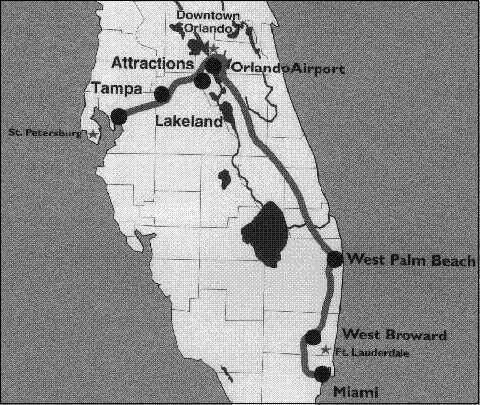
The FOX would extend from Miami to Orlando and Tampa, a distance of 322 miles. FOX
information indicates that:
There would be seven stations: Miami Airport, West Broward, West Palm Beach,
Orlando Airport, Orlando Attractions, Lakeland, and downtown Tampa.
Trains would operate at up to 200 miles (322 kilometers) per hour--faster than the
present top speed of 186 miles (300 kilometers) per hour operated on some French
services. All crossings would be grade separated.
Travel time from Miami Airport to Orlando Airport would be 1:33, with an
additional 55 minutes required to reach Tampa.
Coach class fares would be $54 from Miami to Orlando, $22 from Orlando to
Tampa, and $65 from Miami to Tampa. First class fares would be $108, $39, and
$124.
One train per hour would be operated in each direction. The highest service levels
would be achieved during peak periods with two trains per hour.(54)
Service from Miami to Orlando would begin in 2004, and service to Tampa in
2006.
FOX is projected to carry approximately 6.2 million passengers per year or 17,000 daily.(55)
It is forecast that 45 percent of FOX riders would be diverted from automobiles, 31
percent from airlines, and 24 percent would be new trips.
Summary of Financing: FOX would be built under a "public-private partnership"
between FDOT and FOX. FOX would operate the system for 40 years under a franchise
awarded by FDOT. Construction costs and the cost of the trains is projected at $5.4
billion, with infrastructure debt at $6.5 billion (nominal dollars). The state would own the
infrastructure (right of way, rail and improvements), while FOX would own the trains.
FOX would contribute $350 million in equity. Public funding of nearly $3.5 billion would
be provided: $3.0 billion from FDOT, $300 million from the federal government, $100
million from Orlando International Airport and $50 million from Miami International
Airport. Construction capital would be provided through the issuance of tax exempt bonds
secured by passenger revenues and issued by a special district to be established by state
legislation. In addition, FDOT seeks at least some federal backing of the bonds.
Status: FDOT and FOX are working toward a target date of June 30, 2000, for
certification of the project, with construction to commence thereafter. Milestones have
been set for various dates leading up to certification and failure to meet any milestone
could result in cancellation of the project. Perhaps the most important milestones are set
for January 31, 1998:
Enactment of federal legislation granting $300 million for the project and
guarantees or credit enhancements with respect to the bonded debt.
Enactment of state legislation authorizing FDOT to guarantee that the FOX system
will be completed and operated.
Written assurances from Miami International Airport and Orlando International
Airport that their aggregate contribution to the project of $150 million is
"reasonable and obtainable."(56)
Currently, approximately $9.5 million is being spent on additional studies and legislative
advocacy ($435,000). Most of the work, including a $2.25 million detailed ridership
projection, is being performed by FOX, which is being reimbursed by FDOT at a 75
percent rate. If the current agreement ("Pre-Certification Post-Franchise Agreement") is
terminated before January 31, 1998, FDOT would be obligated to pay 100 percent of
FOX's costs (even if the termination is initiated by FOX).
The Market
Despite being the nation's fourth largest state and having four metropolitan areas of a
million or more, conditions for high-speed rail are less favorable in Florida than in the
other markets. Mass transit is sparse and ridership per capita is half that of the national
average. There is virtually no network of connecting rail service (see Table 5).(57)
Population and Urban Densities: The population of the metropolitan areas along the
FOX corridor is 8.4 million. Each of the high-speed rail corridors described above has a
higher population in at least one of its terminal urban areas alone. Urban population
densities in the Miami-Orlando-Tampa corridor are far lower than in the other high-speed
rail corridors. The Miami-Orlando-Tampa corridor is virtually the same length as the
Tokyo-Nagoya-Osaka corridor, and the major cities are separated by mileage similar to that
separating the Florida urban areas.
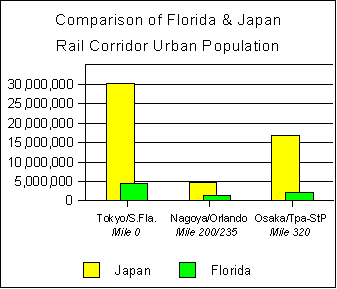
The developed areas of Miami-Fort Lauderdale-West Palm Beach, Orlando and
Tampa-St-Petersburg could accommodate the population of Tokyo, Nagoya and
Osaka respectively with room left for Orlando and Fort Myers-Cape Coral (Chart 1:
Comparison of Florida and Japan Rail
Corridor Urban Population).(58)
The developed area of Tampa-St.
Petersburg could accommodate the
13 million people who live in the
Chicago and Dallas-Fort Worth
metropolitan areas at Paris
metropolitan densities.
Developed Orlando could
accommodate the metropolitan
populations of Seattle, Denver and
Portland (Oregon) combined at Paris
metropolitan densities.
Other high-speed rail corridors are more densely populated, which increases demand. The
Tokyo-to-Osaka population per route mile is 163,000; Paris-to-Lyon is 46,000, and
Washington-to-New York is 113,000. In contrast, the Miami-Orlando-Tampa corridor
population per route mile is only 26,000, barely half the weakest high-speed rail market.
Even Florida's high rate of growth will change these ratios little in the foreseeable future.
The relatively low population density along the Miami-Orlando-Tampa corridor would
make it more difficult to attract riders.
Local Transit Connections: Unlike other high-speed rail applications, the FOX system
would not be supported by either extensive transit connections or by a proclivity on the
part of Floridians to use transit services. Comprehensive metropolitan rail transit systems
serve high-speed rail stations in Tokyo, Nagoya, Osaka, Paris, Lyon, New York, and
Washington, together with frequent bus service.
Transit ridership in the Tokyo area is more than double that of the entire United States,
while combined Tokyo-Nagoya-Osaka transit ridership is nearly four times total U.S.
ridership.(59)
Paris and Lyon transit ridership is more than 3 billion annually, while New
York-Washington corridor ridership is more than 2.5 billion. In contrast, all of the transit
systems in the Miami-Orlando-Tampa corridor combined carry less than 120 million
passenger trips--less than 1/20th that of the New York-Washington or Paris-Lyon
corridor and nearly 1/200th that of Tokyo-Nagoya-Osaka.(60)
Among the 39 U.S.
metropolitan areas of more than one-million population in 1990, Miami-Fort Lauderdale
ranks 18th in per capita annual ridership; Tampa-St Petersburg is 38th and Orlando is
39th (last). Weak Miami-Orlando-Tampa corridor transit ridership would be a significant
deterrent to high-speed rail ridership. This deficiency is so severe that it cannot be corrected
by a FOX shuttle bus system or any transit improvements under consideration.
Connecting Intercity Rail Network: While Japanese and French high-speed rail lines are
supported by extensive intercity rail connections serving 100 million or more people,
almost no one can connect to the FOX line by frequent rail service. Two daily round trip
Amtrak trains serve Orlando and one serves Tampa (in the middle of the night). Despite its
close proximity to Florida, there is no direct service to Atlanta. An Amtrak trip from
Atlanta to Orlando would require routing through Washington, D.C., and take more than
39 hours for a trip that can be made by auto in under eight hours.(61)
Tourism: FOX anticipates substantial growth in tourism, which would generate higher
ridership. But future growth may be much more limited than expected. After years of
steady growth, tourism in the Miami-Orlando-Tampa corridor has declined. From 1990 to
1994, tourism dropped by 3.4 percent, a 0.9 percent annual decline. FOX attributes this
drop to the "national and international recession early in this decade." Yet during a similar
period, 1980-1984, Florida's tourism grew 36 percent, an annual increase of 8.1 percent.(62)
The periods were similar in economic growth and both included recessions. Continuing
stagnation or a lower growth rate could make it more difficult for FOX to achieve its
ridership and revenue projections.
Competitive Analysis: Airlines
High-speed rail competes with airlines over distances of less than 500 miles, performing
virtually the same function as an
airline. FOX projects that high-speed
rail would attract more than
Air and Rail Travel Time: Door-to-door high-speed rail travel times are
likely to be similar to airline times
from South Florida to Orlando.
High-speed rail travel times should
have up to a 15 minute advantage
from Miami to Orlando Attractions.
FOX would have an "overhead" time advantage(63)
to Orlando Attractions by virtue
of its station at that location. Travelers to that station would arrive closer to
recreational and entertainment sites, reducing overall travel time compared to
airlines.
However, FOX would have up to a 15 minute disadvantage to Orlando destinations
served from the Orlando International Airport station.
High-speed rail is also likely to have a considerable disadvantage--up to one hour--from
Tampa to Miami. This is because FOX would operate over a longer route through
Orlando. Despite an hour travel time disadvantage, FOX predicts that it would attract
more than 50 percent of the Miami-Tampa air market.
Airline service is much faster between Tampa and South Florida because it operates directly
between Tampa and South Florida, not through Orlando (see Table 7, page 25). This
illustrates one of high-speed rail's most daunting difficulties--the inflexibility of its route
infrastructure. High-speed rail requires expensive infrastructure between terminals, making
it prohibitively expensive to provide speedy service to more than one market. Airline route
infrastructure is much less expensive, and consists primarily of computers.
Further, FOX will not have an advantage typical of most high-speed rail
systems--downtown stations--which make high-speed rail competitive with airlines for
downtown oriented trips. FOX's only downtown station, Tampa, serves a relatively weak
commercial center that contains only 3 percent of the metropolitan area's employment.
Air and Rail Travel Costs: FOX anticipates a considerable price advantage relative to
airlines. First class rail fares are to be 28 percent below airline first class fares and full
economy fares are to be 40 percent below airline economy fares.
However, the projected FOX rail fare advantage over air fares has already disappeared.
Within the last two years, the nation's leading low fare airline, Southwest Airlines, entered
the Tampa-to-Fort Lauderdale market. And in 1996, Southwest entered the Orlando-to-Fort Lauderdale market. As has routinely occurred in other U.S. air markets, major airlines
have matched the new lower fares of the new market entrant. Further, the impact of lower
fares is felt in adjacent airline markets in the same metropolitan areas. Air patrons in the
Miami-Fort Lauderdale area are served by two airports with substantial commercial service,
Miami International and Fort Lauderdale International. The considerably lower fares in the
Fort Lauderdale-to-Orlando and Tampa markets attract patrons that might otherwise fly
from other airports, especially Miami.
Fort Lauderdale's market share of
Miami/Fort Lauderdale-to-Orlando
(Chart 3: Airline Market
share: Orlando to South Florida; 1996:
First Nine Months & Last Three
Months).
Moreover, the cost competition at
Fort Lauderdale has put downward
pressure on fares at Miami
International Airport. Air fares have
dropped substantially since 1995 (see
Table 6). The average fare in all
markets combined had dropped to 44
percent below FOX's projected airline discount economy fare and 59 percent below FOX's
projected full economy air fare. In recent months, airline fares have dropped more than 30
percent in Florida, which, according to FRA, should reduce high-speed rail ridership by at
least 30 percent (Section III, above) to 4.2 million or less. Average air fares in 1996(65)
are
estimated to be at least 15 percent below the proposed average FOX fare in 2010.(66)
The 1996 fares still may not reflect the full effect of the increasing competition in Florida's
air markets, because they do not reflect a complete year of heightened competition. In the
first full quarter after Southwest Airlines entered the Orlando-to-Fort Lauderdale market,
the average fare dropped 22 percent to $43.80.(67)
By March 1997, Southwest Airlines'
unrestricted one-way fares between Tampa and Fort Lauderdale and between Orlando and
Fort Lauderdale were $65. It was not possible to pay a higher fare. Discount fares had
dropped to as low as $22 between Miami and Orlando.(68)
Competitive Positioning: Moreover, it is reasonable to expect that the airlines will
become even more competitive as time passes.
U.S. airline fares per passenger mile have been steadily declining, a drop of more
than 40 percent from 1984 to 1994 (inflation adjusted).(69)
Preliminary data indicates
a continuation of the same rate through 1996.(70)
Smaller regional jets will replace propeller driven aircraft on shorter routes, which
will further reduce costs. Some of the commercial flights in the Miami-Orlando and
Miami-Tampa markets are propeller driven. Because many people avoid propeller
driven aircraft, substitution of jet for propeller aircraft will increase the
attractiveness of air service.
Larger, more efficient jets are also being introduced. For example, Southwest
Airlines will soon operate 162-passenger Boeing 737-800 jets. Other carriers may
substitute larger and more fuel efficient aircraft, such as Boeing 757's, next
generation McDonnell-Douglas MD-80s or new Airbus models. This is likely to
reduce airline costs in the Tampa- and Orlando-to-South Florida markets and will
make it possible for airlines to accommodate a substantial increase in passengers
without adding flights.
The more established, larger airlines are likely to continue to become more cost
effective as they implement more efficient labor-management work practices and
establish more competitive subsidiaries (such as the United Airlines' "Shuttle").
Additional entrepreneurial airlines may enter the market.
The airlines are already providing daily departures in excess of the 24 that FOX asserted
would not be possible. Air service frequencies now exceed FOX's "impossible" threshold by
30 percent in both the Orlando-Miami and Tampa-Miami markets. In these and other
markets the only barrier to higher service levels in other markets is insufficient demand.(72)
The airline industry is dynamic and volatile. The average airline fare in the Tampa-South
Florida and Orlando-South Florida markets is already below the proposed average rail
fares. It is probable that air fares will continue to decline in real terms. But even if they
were to increase, airlines can be expected to respond to a new entrant's lower fares by
meeting them, as they have in virtually every previous case.
Competitive Analysis: Automobile
High-speed rail has been more successful in attracting airline passengers than auto users.
FOX projects that its trains would attract a much smaller percentage of the automobile
market, 6 percent. However in some markets, the FOX projects that rail market share
would be higher at more than 15 percent in the Miami-Orlando market and 11 percent in
the Orlando-Ft. Lauderdale market.
Auto and Rail Travel Times: FOX trains are likely to provide door-to-door
improvements over automobiles of 1:15 to 1:30 from Miami to Orlando and Tampa.
However, the automobile is likely to be 25 or more minutes faster than high-speed rail
from Tampa to Orlando (see Table 7).(73)
Auto and Rail Travel Costs: Travel by high-speed rail would generally be more expensive
than by automobile (see Table 8).
The cost difference between nonbusiness auto and rail trips would be the greatest, because
people tend to consider only the variable cost of automobile travel when making trip
decisions--the cost of gasoline and tolls. Travel would be from two to 20 times as
expensive by rail, including parking and taxi charges. (The cost would be greater if an auto
is rented at the destination.) The differences would be even greater for families and
multiple person travel. The availability of a personal automobile at the destination is an
advantage of auto travel relative to high-speed rail, adding further to rail's cost and
convenience disadvantage.
Business travel by rail would be from 33 to 250 percent higher than fully costed travel by
auto, depending on whether a cab is hired or an auto is rented at the destination. The gap
between rail and auto would widen if more than one person were on the business trip.
(Chart 4: Miami-Orlando Business Trip: Costs.)
Moreover, the cost of automobile
travel has been declining in
A
continuation of this trend would
make FOX travel less attractive for
automobile trips.
FOX would effectively compete for
longer auto business trips along the
corridor. FOX's more than one-hour
time advantage may negate some or
all of its disadvantage in price as long
as no more than one person is on the
trip. FOX would be at a great disadvantage in the nonbusiness auto trip market, where its
relative costliness is unlikely to offset its travel time advantages.
Short Trips: FOX projects that more than 1.7 million passengers would be attracted
annually from the Interstate 4 corridor between Tampa and Orlando, more than 5 percent
of the automobile market. This includes trips between Tampa and Lakeland (35 miles),
Lakeland and Orlando (49 miles), and Tampa and Orlando (84 miles). FOX's projections
are so dependent upon the I-4 corridor that only 40 percent of passenger diversions from
auto to high-speed rail come from other portions of the route.
U.S. Department of Transportation data indicates that the overwhelming majority of
intercity trips of less than 100 miles are by automobile. Less than 0.5 percent of such trips
are by airplane. Air travel tends to be slower than auto travel times because of the overhead
time--traveling to the airport, checking in, and waiting to depart. As a result,
approximately 99 percent of travel in such short travel markets is by auto. High-speed rail
would face virtually the same competitive disadvantages.
In a short corridor, an automobile averaging 45 to 60 miles per hour (or faster) can
provide a faster door-to-door trip than an airplane capable of 600 miles per hour or a train
capable of 200 miles per hour. If Tampa-Orlando were a lucrative high-speed market,
significant numbers of people would be using airlines today, but they are not. An
additional factor limiting airline and high-speed rail in short corridors is their high cost
compared to automobile travel (see Table 8).
In contrast, FOX projects a much smaller diversion from automobiles in the Miami-to-West Palm Beach corridor, despite its similar length and much higher travel demand. FOX
projects the Miami-West Palm Beach corridor auto diversion at less than 1/15th the I-4
corridor rate. Most improbably, auto users are projected to use FOX in the 35 mile Tampa-to-Lakeland market more than in the 75 mile Miami-to-West Palm Beach market. FOX
does not explain why people in central Florida would have such a greater propensity to ride
high-speed rail than people in South Florida.(77)
Evaluation
Prospects for high-speed rail appear less than favorable in the Miami-Orlando-Tampa
corridor.
Florida and Other High-Speed Travel Markets: The Florida market is considerably less
favorable for high-speed rail than other markets.
Low population and population density: Population and population density are
considerably less favorable for high-speed rail in Florida than in Japan, France, or
even the New York to Washington corridor.
No ridership from connecting intercity rail: Unlike Japan and France, Florida would
have no market of existing rail riders to make up the bulk of high-speed rail
ridership, as other rail services of significance do not exist. In both Japan and France
a significant percentage of high-speed rail riders have been attracted from other
existing rail services.
Weak and poorly used transit systems: Transit use and connections are meager in
the Miami-Orlando-Tampa corridor.
Competitive airline market: Unlike Japan and France, high-speed rail in Florida
would not be protected from competition by government policy. Air fares,
therefore, are likely to be the same as rail fares.
Far less expensive auto travel: Unlike other high-speed rail corridors, automobile
trips would be considerably less costly in Florida (Chart 5: Personal Trip Costs).
The FDOT-FOX projections reflect the weakness of the Florida market. While Japan's
most successful line carries 138,000 person miles of travel per route mile each day, the
FOX system would carry 7 percent as
Ridership: The FOX ridership
projection appears to be extremely
optimistic for the following reasons:
FOX's forecast of a 65 percent
capture of the air market is
exceedingly high. In the New York-Washington market, Amtrak's high-speed services attract only 40 percent
of the market despite a more than 40
percent price advantage. FOX is not
likely to have a fare advantage and seems likely to do less well than Amtrak.
Diversion from automobiles appears to be overstated, especially in the Orlando-Tampa market. Further, FOX auto diversion projections are high in Orlando-to-South Florida markets. FOX anticipates attracting more than 11 to 15 percent of
Orlando-Miami and Orlando-Fort Lauderdale automobile trips. Diversion from
autos in the Paris-Lyon corridor is only 10 percent, despite perceived automobile
costs that are 20 percent above rail fares. In Florida, the perceived cost of traveling
by auto in this corridor is approximately 50 percent below the economy rail fare.
FOX projected ridership appears to be higher than the total ridership within the
Paris-Lyon corridor, where 75 percent of the riders begin or end their trips at
points beyond Paris and Lyon.
Revenue: Similarly, the FOX commercial revenue projections appear to be overly
optimistic. Without much larger subsidies, average FOX fares could be no more than the
going market rate--the average airline fare.
It is inconceivable that FOX would be able to price its tickets at 28 percent to 40
percent below airline fares. Airline fares have already fallen below FOX projected
fares.(79)
The airlines would have more flexibility to reduce air fares than FOX, because airline
fixed costs (capital costs and debt service) are a much lower percentage of overall
costs. Airlines typically have fixed costs of below 25 percent,(80)
while FOX's fixed
costs would be at least 55 percent, assuming that its operating and capital costs are
no higher than projected. If airline productivity continues to improve at 1980-1996
rates, FOX fares would need to be set below the level required to cover fixed costs.
National studies have predicted that commercial revenues would fall far short of
system costs. FRA projected commercial revenues at 37.7 percent of Miami-Orlando-Tampa costs in 2020. In that year FOX projects a profit.
Operating Costs: FOX operating costs appear to be optimistic. According to FDOT, FOX
operating expenses "appear to be underestimated by at least 10 percent."(81)
High-speed rail
operating costs have been estimated at from 29 percent to 122 percent above FOX
proposed costs.(82)
FOX's costs per train mile are projected at less than one-half those of
Amtrak.
Receipt of federal funding could substantially increase operating costs. Federal passenger
rail and transit assistance has been subject to federal labor protection provisions that
require up to six years (yes, years) severance pay to laid-off employees. FOX has indicated
that it does not expect to be subject to federal labor protection, which would make FOX
the only federally funded surface transportation so exempted. This seems unlikely. Federal
labor protection provisions are expensive. In Amtrak's case, potential labor protection costs
have been estimated at between $2 billion and $5 billion. Transit costs are estimated to be
up to $2.5 billion higher annually because of federal labor protection (15 percent of
operating costs).(83)
There is considerable uncertainty surrounding high-speed rail operating costs. No similar
high-speed rail technology has been operated in the United States, and operating cost
forecasts have been inaccurate on many other infrastructure projects (Section IV).
Capital Costs: The costs of constructing high-speed rail in the United States have been
estimated at from 14 percent to 114 percent above FOX projections. Some large
infrastructure projects have experienced much greater cost escalation, up to 300 percent. It
would be prudent to plan for capital costs escalation of up to 100 percent (Section IV).
Any delay after construction starts would produce an estimated $250 million in interest
charges annually. And acceptance of federal funding could substantially increase capital
costs due to federal mandates and labor protection provisions.
Overall Evaluation: Three cases were prepared for evaluation of the FOX proposal (see
Table 9 and Appendix)
Optimistic Case: The Optimistic Case assumes that FOX would be able to achieve
its anticipated average fare per passenger and would attract 35 percent of the air
market. This is nearly as much as rail in the New York-Washington market, which
has substantial fare advantage relative to airlines. The automobile market share is
assumed at the Paris-Lyon rates. In all three cases, an adjustment is made to reflect a
more realistic estimate of FOX's ability to attract automobiles in the Orlando-Tampa corridor. The most conservative operating and capital cost escalation values
are used. This case is considered highly optimistic because (1) rail does not attract
such a large air market share where fares are competitive, (2) the highly automobile-oriented Florida market is less likely to switch to rail, (3) and large infrastructure
projects are often far more costly to build and operate than the low cost escalation
assumptions used.
Realistic Case: The Realistic Case assumes that FOX fares would drop to meet the
current 13.6 percent airline average fare advantage. A 25 percent air market share is
assumed, while attraction from automobiles is reduced by approximately 30 percent.
Capital and operating cost escalation is estimated at the midpoint between the
Optimistic Case and the Pessimistic Case.
Pessimistic Case: The Pessimistic Case assumes that FOX fares would have to be
reduced by 47.5 percent to meet the lower airline fares permitted by continued
airline productivity improvements and that high-speed rail's air market capture
would be 20 percent. Attraction from automobiles is estimated at Swedish rates.
The highest cost escalation estimates (over 100 percent) are used. Cost escalation
could be more significant, however, because large infrastructure projects have
experienced cost escalation of up to 300 percent.
Downward Orlando-Tampa Adjustment The results of this evaluation follow (see Table 10):
Optimistic Case: Ridership would be 2.8 million, 55 percent below the FDOT-FOX projection. The net present value on the FDOT subsidies would be $4.3
billion (as contrasted with the $0.285 billion projected by FDOT-FOX [1996$]).
Project revenues would be insufficient to service debt by 2007. To keep the system
afloat, the state would need to appropriate $10.8 billion in addition to the planned
$3.0 billion.
Realistic Case: Ridership would be 2.0 million, 66 percent below the FDOT-FOX
projection. The net present value on the FDOT subsidies would be $9.9 billion
(1996$). Project revenues would be insufficient to service debt by 2006. To salvage
the project, the state would need to appropriate $23.0 billion in addition to the
planned $3.0 billion.
Pessimistic Case: Ridership would be 1.1 million, 82 percent below the FDOT-FOX projection. The net present value on the FDOT subsidies would be $15.1
billion (1996$). Project revenues would be insufficient to service debt by 2005. To
keep the project operating, the state would need to appropriate $35.5 billion in
addition to the planned $3.0 billion.
55% below FOX 68% below FOX 82% below FOX 44% below FOX 66% below FOX 88% below FOX (4th Year) (3rd Year) (2nd Year) Construction delays could worsen the results. An 18 month delay, similar to the delay that
occurred at Denver International Airport, would have the following impacts (see Table
11):
Optimistic Case: The net present value of state subsidy would decline to $4.7
billion (1996$).(84)
Realistic Case: The net present value of state subsidy would decline to $10.1 billion
(1996$).
Pessimistic Case: The net present value of state subsidy would decline to $15.7
billion (1996$).
No adjustment made for delayed growth in ridership. The results are considerably less favorable than the FOX projections primarily because
adjustments are made to compensate for two excessively optimistic FOX expectations:
FOX's airline market share projection of more than 65 percent is above any
reasonably achievable level in the competitively priced air market that has developed.
FOX's projected Orlando-Lakeland-Tampa attraction of passengers from
automobiles is considerably higher than can be reasonably expected in such a short
travel market.
The commercial revenues projected in the Realistic Case are nearly identical to the level
forecast for the Miami-Orlando-Tampa corridor by FRA.(85)
Sensitivity: Relatively minor forecasting errors could significantly increase the state's
obligation.
If FOX were to achieve its projected ridership (highly unlikely), charge market fares
(no higher than airline fares) and experience no capital and operating cost escalation,
additional state appropriations of $2.5 billion would be required.
If FOX were to achieve its projected ridership (highly unlikely), charge market fares
(no higher than airline fares) and experienced a modest 10 percent cost escalation,
an additional state appropriation of $4 billion would be required, and project
revenues would be insufficient to make bond payments by 2012.(86)
The policy initiatives that could theoretically make it possible for FOX to meet its revenue
projections are improbable. The airline industry is unlikely to be returned to the expensive
and non-competitive regime of regulation. It is inconceivable that gasoline taxes would be
raised to Japanese, much less European, rates. And, if gas taxes were raised, there would be
no need for high-speed rail because Florida's tourism industry would be decimated.
Automobile tourism would be significantly reduced, while the resulting economic
dislocation would make air travel unaffordable to many people.
The conditions under which high-speed rail could be successful are not reasonably
achievable.
...it appears that HSGT (high-speed rail) could break even only if costs were low compared
with typical estimates for such systems, if fares were high compared with current air fares,
and the new system captured a market equal to or greater than the current air travel
volume in the corridor. Such a combination of factors, though possible, is remote.(87)
Financial Arrangements
Infrastructure Debt: The high-speed rail system would require federal credit
enhancements that could involve bond guarantees of up to $6.5 billion, as proposed. (It
seems unlikely that the bonds would be marketable with less than 100 percent federal
backing.) Federal credit enhancements could create a contingent financial liability of up to
$130 billion for the federal government, as other states seek similar treatment for their own
future infrastructure bond issues.(88)
While FOX's financial risk is limited, the state's is not. The project would require a state
guarantee to debt holders that the FOX rail line would be completed and operated
(completion covenant). In the likely event that project funds are insufficient to meet bond
payments:
The project could be canceled after construction begins. If cost escalation is at
Denver International Airport, Central Artery, etc. rates, it could be more prudent to
cancel the project before completion and simply pay the debt holders. But cost
escalation occurs little by little. There is rarely a point in a project's development
that the incremental cost escalation appears to be so significant that policy makers
find cancellation a viable option. And, as time goes on the prospects for cancellation
diminish. However, given the two stage construction schedule (Orlando-to-Miami
followed by Orlando-to-Tampa), there might be some potential for canceling the
Orlando to Tampa segment in response to the cost escalation.
The special district could negotiate a financial bailout, following the model of
Eurotunnel. This could involve significant losses to both the state and debt holders.
The special district could default on debt service, as occurred in the 1980s with the
Washington Public Power Supply System (WPPSS).(89)
But the completion covenant
would still bind the state, while the federal government would be required to pay
the bonds (assuming a federal government bond guarantee). No state of Florida
agency has defaulted on bonds during the last 100 years.
The FOX bonds would not be guaranteed by the "full faith and credit" of the state.
However the state's completion covenant produces virtually the same effect, the state
would ensure that the system would be completed and operated. Moreover, FDOT has
noted that the FOX bonds could have a negative effect on the state's credit rating(90)
--the
state's ability to finance school construction or other important public purposes could be
impaired.
Minimum Support Payment: In January 1996, FDOT indicated its determination to
limit minimum support payments to $70 million annually (current dollars) through 2029,
without adjusting upward for inflation. FDOT has since agreed to escalate minimum
support payments by 33 percent above inflation annually, and extend the payments through
2039.(91)
This represents a 117 percent increase over the maximum amount FDOT indicated
would be an acceptable condition for continuing the project ($1.6 billion in 1995$).(92)
Considerable future increases are anticipated by this report.
Fixed Price Contract: It is anticipated that FOX would build the system for a guaranteed
maximum cost. A number of factors could make this impossible, such as unforeseen
environmental or other project requirements and the uncertainty attendant to cost
estimates for technology unfamiliar to the U.S. environment. Moreover, the guaranteed
maximum price could be substantially above current estimates, similar to the Denver
International Airport cost escalation that occurred in the early months of construction.
Conflict of Interest: FDOT expressed concern that "inherent conflicts of interest" existed
in the FOX proposal because FOX or its affiliates would hold contracts for "design,
construction, equipping(93)
and operation of the system." Subsequent agreements have not
substantially altered this situation.
... conflict of interest considerations should dictate that firms involved in the planning
analysis be prohibited from a major role in the design contracts.(94)
By this standard, FOX has a significant conflict of interest.
The Public-Private Partnership: The FOX system is a public-private partnership in which
state subsidies, federal subsidies, and airport contributions represent approximately 90
percent of non-commercial funding, while the private contribution is approximately 10
percent.
Further, under the FDOT-FOX agreements, the FOX profit is paid from system revenues
before state bond payments are made. Thus, FDOT could be required to pay FOX a
guaranteed rate of profit (12.68 percent of commercial revenues) even if revenues were
insufficient to pay infrastructure bonds. FOX and FDOT intend to identify a return on
investment level to which FOX would be entitled over the 40 year project life. FOX hopes
to earn a healthy 15 percent after tax return on investment. FOX or FOX partners would
make additional profits in producing planning studies, rail cars, and constructing the
infrastructure.
For example, if passenger revenues were 50 percent below projection, FOX would be paid
$275 million in profits, while the state would have to increase its subsidy by $9 billion. If,
in addition, construction costs doubled, FOX would be paid the same $275 million profit,
but the state would have to increase its subsidy by $18.5 billion.
FOX, like any other commercial enterprise, would seek to achieve the projected results.
However, virtually all of the "downside" risk belongs to the state. FOX's profits are paid
before debt service. The state has a much greater financial stake in the project. Its minimum
commitment of $3.0 billion is equal to 13 percent of state taxes in 1997. FOX's
commitment of $350 million is approximately one percent of the gross revenues of the
four partners, and less than half of 1996 pre-tax net profits (after taxes).(95)
Safety
It is not clear that FOX would improve safety. At equal levels of usage high-speed rail is
safer than automobile travel. But highway investment, especially construction of interstate
standard highways, reduces traffic and injuries. It has been estimated that each $1.7 million
spent constructing interstate standard roadways reduces traffic fatalities by one and injuries
by 60.(96)
A $3.0 billion higher FDOT investment in expressway construction or
improvement could reduce traffic fatalities by 1,700 and injuries by 105,000 over the next
40 years.(97)
On the other hand, automobile traffic diverted to FOX could be expected to
reduce traffic fatalities by 400 and injuries by 34,000.(98)
Diversion of travel from airlines is
projected to reduce fatalities by three and injuries by one.(99)
Even at the inflated FOX
ridership projections, state investment in FOX trains would yield a lesser safety return than
highway investment, increasing traffic fatalities by nearly 1,300 and injuries by 71,000.
This perhaps surprising conclusion results from the relatively small percentage of highway
users that FOX estimates would be diverted from Florida's highways.
Winglock
The extent of air traffic congestion (winglock) has been overstated. In fact, more air space
is being built by advances in the air traffic control system, free-flight routing, and global
positioning systems. Commercial airlines are capable of carrying any reasonably expected
demand in the United States, including Tampa-South Florida and Orlando-South Florida.
Perhaps the most important barrier is the outdated state of the nation's air traffic control
system, which is to be significantly improved by 2010.
Even so, FOX would have little impact on Florida's airports. The FDOT projected
reduction of 21,000 flights in 2010 is simply not significant in 2010. It is only 60 flights
daily, barely 2 percent of the daily air carrier operations at the five airports. Moreover, all
airports intend to expand to accommodate the increasing demand. Miami International
Airport has begun an expansion project that will nearly double its capacity. Tampa
International Airport intends to expand as required. Orlando International Airport,
currently operating at 74 percent of capacity, is planning expansion as demand requires; it
has sufficient land for unconstrained growth.(100)
None of Florida's airports is scaling back
future investment plans in response to high-speed rail.
High-speed rail versus airport expansion: High-speed rail is not a cost effective
alternative to airport expansion. The capital cost of high-speed rail per annual passenger is
at least seven times as much as the cost per annual passenger of the current Miami
International Airport expansion.(101)
Indeed, high-speed rail's construction cost per annual
passenger is five times that of Denver International Airport despite that facility's reputation
for cost escalation.(102)
Moreover, airport expansion would be paid for by users,(103)
unlike the
FOX high-speed rail line, which would require billions in non-user subsidies. Further, a
large proportion of the air system user revenues that finance airport expansion would be
paid by people from outside Florida, while most of the public subsidy for FOX would be
paid by Floridians.
Gridlock
It is more difficult to control the increase in automobile traffic congestion, but the FOX
and FDOT data demonstrate that high-speed rail would provide little relief (see Table
12).(104)
Diversion from Autos: Peak and Lowest Traffic Points: High-speed rail would attract a
minuscule percentage of autos at peak highway traffic points.
In the Miami-Orlando corridor, FOX projected diversion from autos represents 0.5
percent of traffic at the busiest point (Broward County, I-95, and Florida's
Turnpike), one out of every 200 cars. The Realistic Case projects one out of every
500 cars.
In the Miami-Tampa corridor, FOX projected diversion from autos represents 0.2
percent of traffic at the busiest point (Hillsborough County, I-75),(105)
one out of
every 500 cars. The Realistic Case projects one out of every 1,000 cars.
High-speed rail would attract a greater portion of traffic where there is little congestion
and no immediate need for expanded highway capacity.
In the Miami-Orlando corridor, FOX projected diversion from autos represents
11.3 percent of traffic at the lowest point (Osceola County, Florida's Turnpike),
one out of every nine cars. The Realistic Case projects one out of every 18 cars.
Traffic growth is unlikely to require additional lanes until 2040.(106)
In the Miami-Tampa corridor, FOX projected diversion from autos represents 1.4
percent of traffic at the lowest point (Collier County, I-75), one out of every 70
cars. The Realistic Case projects one out of every 165 cars. Traffic growth is
unlikely to require additional lanes until after 2050.
High-speed rail versus highway expansion: One of the fundamental public purposes of
high-speed rail is to alleviate traffic congestion, thereby reduci
Because Florida has a fast growing population of residents and visitors, many highways and
airports are near or exceed design capacity. Expansion plans for these transportation
facilities have not been able to keep up with the demand for services.(3)
Emphasis on the development of intercity rail service will be placed on the following
corridors: Tampa-Orlando; Orlando-Miami.(5)
Table 1
Proposed Public Purposes of High-Speed Rail
(Benefits to Florida)
Auto traffic reduction and reduced highway investment
Air traffic reduction and reduced airport investment
Environmental benefits
Improved highway safety
Economic benefits
Table 2
Passenger Transport Market Share: 1994
(Person Miles)
Auto
Bus
Rail
Airline
United States
87.0%
3.4%
0.3%
9.3%
European Union
79.7%
8.3%
6.2%
5.8%
Japan
51.5%
8.7%
34.5%
5.3%
Table 3
Change in Passenger Transport Market Share:
1980-1994
Auto
Bus
Rail
Airline
United States
-1.7%
-8.0%
-23.4%
25.1%
European Union
3.7%
-27.3%
-27.2%
80.6%
Japan
24.3%
-38.9%
-14.9%
39.5%
In nearly all these markets, break-even operation would require not only low costs but also the
ability to charge premium fares well above airline levels. The combined occurrence of both these
conditions in any one market would be extremely unlikely.(30)
Table 4
High-Speed Rail Corridors
FRA Feasibility Study: 2020
Corridor
Commercial
Revenues
Subsidies
Chicago-Detroit
21.6%
78.4%
Chicago-Milwaukee-Detroit-St. Louis
22.8%
77.2%
Chicago-St. Louis
13.6%
86.4%
Eugene-Portland-Seattle-Vancouver
17.0%
83.0%
Houston-Dallas-Austin-San Antonio
42.7%
57.3%
Los Angeles-San Diego
15.6%
84.4%
Miami-Orlando-Tampa
37.7%
62.3%
San Francisco-Los Angeles-San Diego
31.8%
68.2%
Washington-New York-Boston
55.3%
44.7%
Average: High-Speed Rail
28.7%
71.3%
Exhibit: Amtrak 1994
43.6%
56.4%

Table 5
High Speed Rail Corridors
Demographic Factors
Population
(Millions)Population per
Line MileAnnual Transit
Ridership per
Capita
Tokyo-Osaka
52.0
163,000
436
Paris-Lyon
11.6
46,000
284
New York-Washington
25.5
113,000
105
Miami-Orlando-Tampa
8.4
26,000
14
65
percent of the air market between
Tampa and South Florida and between
Orlando and South Florida. FOX
expects to attract 80 percent of the
Miami-to-Orlando air market. (Chart
2: Projected Market Share: 2010).
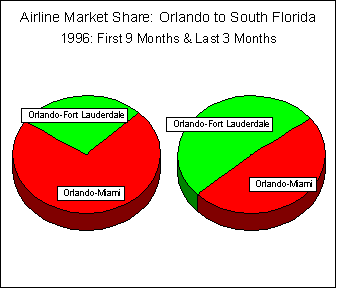
air travel nearly doubled after
Southwest Airlines entered the
market(64)
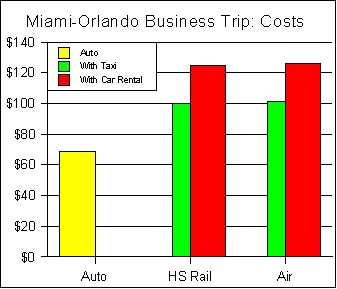
Table 6
Comparison of FOX 1995 Air Fares and Actual 1996 Air Fares
Market
FOX 1995 fares
1996 Fares
Full Economy
Discount
Economy
Restricted
Economy
Average
Fare
Compared to
1995
Discount
Economy
Orlando-Miami
$204.00
$145.00
$69.00
$84.66
-41.6%
Orlando-Fort Lauderdale
$213.00
$160.00
$65.00
$55.80
-65.1%
Orlando-West Palm Beach
$262.00
$149.00
$99.00
$90.42
-39.3%
Tampa-Miami
$199.00
$154.00
$29.00
$80.48
-47.7%
Exhibit: Tampa-Fort Lauderdale(71)
$51.46
Weighted Average
$205.73
$150.64
$57.18
$83.74
-44.4%
Excludes Passenger Facility Charge ($3.00)
Table 7
Estimated Travel Time(74)
Corridor
Auto
Air
High- Speed
Rail (HSR)
HSR Advantage
Relative to
Auto
Air
Miami-Orlando Airport
4:23
2:58
3:07
1:16
-0:09
Miami-Orlando Attractions
4:23
2:58
2:48
1:35
0:10
Miami-Tampa
5:12
2:38
3:40
1:32
-1:02
Tampa-Orlando
1:33
2:20
2:07
-0:34
0:13
Tampa-Orlando Attractions
1:11
2:20
1:35
-0:24
0:45
inflation
adjusted terms. From 1980 to 1994,
the total cost per vehicle mile of
automobile travel declined by 20
percent (inflation adjusted).(75)
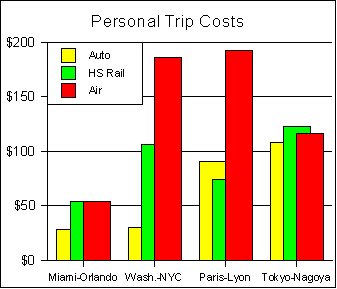
Table 8
Estimated Travel Costs
Trip
Auto
High
Speed
RailAuto Advantage
Compared to
High-Speed Rail
Basic
With
Car
RentalBasic
With
Car
Rental
Miami-Orlando
Personal
$29
$62
$102
$33
$73
Family of 3
$29
$143
$183
$114
$154
Business
$74
$103
$128
$29
$54
Business: 2 People
$74
$180
$205
$106
$131
Miami-Tampa
Personal
$18
$84
$109
$66
$91
Family of 3
$18
$182
$201
$164
$188
Business
$85
$123
$148
$38
$63
Business: 2 People
$85
$221
$246
$136
$161
Tampa-Orlando
Personal
$4
$26
$66
$22
$62
Family of 3
$4
$59
$99
$55
$95
Business
$25
$56
$81
$31
$56
Business: 2 People
$25
$90
$115
$65
$90
For assumptions see endnote.(76)
many person miles, less than 10,000
persons.(78)
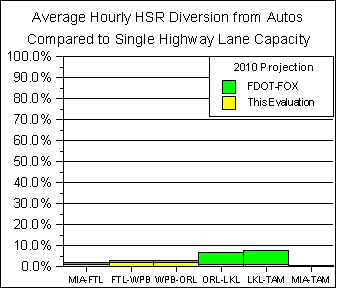
Table 9
Evaluation Assumptions: Summary
Optimistic Case
Realistic Case
Pessimistic Case
Market Rate Fare*
100% of FOX Plan
13.6% Below FOX Plan
47.5% Below FOX Plan
Air Market Share
35% Share
25% Share
20% Share
Diversion from
Autos
Scaled to Paris-Lyon
Rate;
Midpoint of Optimistic
Case & Pessimistic Case.
Downward Orlando-Tampa
Adjustment
Scaled to Sweden
Capture Rate;
Downward Orlando-Tampa Adjustment
Induced Travel
Air & Auto Ratio
Air & Auto Ratio
Air & Auto Ratio
Operating Costs
28.7% over FOX
75.2% over FOX
121.7% over FOX
Capital Costs
14.5% over FOX
64.8% over FOX
115.0% over FOX
* Average Air Fare
Table 10
Evaluation Results: Summary
With On-Time Opening
FOX Proposal
Optimistic Case
Realistic Case
Pessimistic Case
Annual Ridership:
2010
6.2 million
2.8 million
2.0 million
1.1 million
Commercial
Revenue: 2010
$420 million
$237 million
$145 million
$51 million
State Subsidy
Required
$3.0 billion
$13.8 billion
$26.0 billion
$38.5 billion
Net Present Value of
State Subsidy
(1996$)
$0.3 billion
-$4.3 billion
-$9.9 billion
-$15.1 billion
State Subsidy per
2020 Household
$366
$1,708
$3,209
$4,750
First Year Revenues
Insufficient to Pay
Debt Service
Never
2007
2006
2005
1995$ unless otherwise noted.
Table 11
Evaluation Results: Summary
With 18 Month Delay in Opening
FOX Proposal
Optimistic Case
Realistic Case
Pessimistic Case
State Subsidy
Required
$3.3 billion
$14.3 billion
$26.6 billion
$39.3 billion
Net Present Value of
State Subsidy
(1996$)
-$8.2 million
-$4.7 billion
-$10.1 billion
-$15.7 billion
State Subsidy per
2020 Household
$412
$1,760
$3,285
$4,849
No adjustment made for higher operating costs that could occur from the delay.
Table 12
Daily High-Speed Rail Diversion from Automobiles and
Highway Travel Demand: 2010
Peak Traffic Point
Low Traffic Point
Miami-Orlando
Miami-Tampa
Miami-Orlando
Miami-Tampa
Daily Traffic
487,000
118,000
22,000
13,000
Fox Ridership
2,408
186
2,486
186
Percentage
0.5%
0.2%
11.3%
1.4%
This Evaluation Ridership
1,196
78
1,218
78
Percentage
0.2%
0.1%
5.5%
0.6%